
Since I’ve moved to the USA recently, three months ago – to be exact, I couldn’t help to notice some of the differences between Europe and USA. In this post, I’ve decided to share some of them with you. So, here we go:
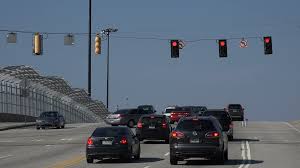
Traffic lights – European countries have fixed traffic lights and the ones in USA are, kind of, hanging on some kind of wire. I’ve found this pretty strange when I first arrived here. For me, it looks like some kind of old fashioned traffic lights and it gives an impression of instability, read – danger.
Trucks – one of the first differences I’ve noticed are the truck shapes in USA. They are definitely much different from the ones you can see in Europe. Picture tells more than a hundred words. So, take a look at the picture bellow. Since this has intrigued me a bit, I did a little research on this topic. This is what I’ve found out: The main difference you see between American and European semi-trucks is the overall design of the tractor unit. In Europe we usually see cab-over trucks. This means that the cabin is situated above the engine. This allows creating flat front surface and the entire truck with its trailer has a cuboid shape. Meanwhile trucks used in US feature something called “conventional cab” design. This means that the cabin is behind the engine. Drivers are sitting further away from the actual front of the truck and look over the long engine cover when driving. In US there are many truck owners-operators. The trucks typically have big and more comfortable compartments while in Europe space is at premium. Conventional cab trucks are more economical because they can have bigger cargo and pull heavier loads and therefore use less fuel that two cub designed trucks. The engine in conventional cab trucks is easier to maintain and fix because it is very easy to reach. In Europe Semi-trucks are limited to 90 km/h, but in some places in US trucks reach 129 and even 137 km/h.

Bureaucracy in USA – no need to bring copies of the documents to the official agencies. Original documents are good enough.
Self-service at retailers – As of Q2 2018, 95 percent of American consumers had encountered at least one form of self-service retail and 49 percent used them on a weekly basis at the supermarket. Recent studies show that 29 percent of self-service users pay with credit card, 28 percent of shoppers would frequent a non-grocer more if it had self-service checkouts, 87 percent of self-service store users do so because it’s faster. Self-service at retailers, in all other countries in Europe, except of UK, France and Sweden, is not present at all, or it’s present at a very low percentage. When it comes to Germany, as one of the biggest and economically most developed EU countries, strange enough, only in January 2018, a self-checkout was introduced into the shops in Hamburg, well developed city and a harbor on the north of Germany. In the last two years there’s been a slight increase in this new technology in Germany but it’s still very much in its infancy stage. While there are roughly 200,000 cashiers in food stores across the country, there are still only 1,450 self-service terminals. Supermarket Rewe is considered a trailblazer in Germany because it started trialing self-service checkouts way back in 2012. It now has a grand total of 62 self-service terminals across its 3,500 stores. This is how Martin Fassnacht, a professor at the WHU business school in Düsseldorf, explains on Germans being so slow in picking up on new technology: “Germans find it particularly difficult to get used to new things. Many Germans simply don’t see the point.”

Most common cars to be seen in USA: Ford, Toyota, Chevrolet, Honda, Dodge, Nissan, KIA. And, let’s not forget to mention that they simply love pick up trucks. It’s no surprise to see some German car brands too. BMW, Mercedes, Audi and some VW cars can also be seen on the streets of USA, however, in a smaller percentage. According to the data compiled by Kelly Blue Book and Business Insider, the Ford F-Series, Chevrolet Silverado, and Ram Pickupare are the top three best-selling vehicles in America through the first half of 2018. Pickup trucks and crossover SUV’s dominate the American market right now. Jeep Cherokee, Jeep Wrangler, and Toyota Tacomaall saw major year-over-year sales increases compared to this time in 2017. Most common car brands in Europe are: VW, BMW, Audi, Mercedes, Volvo, Peugeot, Fiat, Ford, Porsche and Opel-Vauxhall.

Some of the differences when it comes to schools in US and Europe. Schools in USA are more focused on instruction (teaching basic Math, Science, English, etc.), less strict in regards to discipline and respect, more strict regarding dress code or smoking cigarettes, more focused on standardized testing. Schools in Europe are much more focused on education and culture (Philosophy, Art, History, Geography, Languages, etc.), are more strict in regards to discipline, respect and studying requirements are much higher, less strict regarding dress code and smoking cigarettes, more personal environment (no changing of classrooms)…
Driving culture: Although it’s regulated, you can still get your driver’s license in US by age 16 while required age in Europe is 18. True, a 16-year old first needs to obtain a permit for the first six months in order to get a driving license after that. Overall, it’s pretty easy to obtain a driving license. As in Europe, you need to pass a written and a road test. However, the cost of it is as low as 20 dollars, while in Europe it can cost even 700 dollars. Road testing in Europe is far more strict than the one in US. In some European countries, especially SEE, road testers – instructors, are doing their best for the new driver to fail the test. Opposite to that, US driving instructors – testers, are supportive and patient while testing a candidate. More like, if you fail, nobody’s happy, if you pass, everybody’s happy. One other thing I couldn’t help to notice in US is that Americans tend to form orderly car queues in one line of the road, even though they have one more lane available, which goes or turns in the same direction. And, finally, something very uncommon for European countries is driving through the red light. In USA, when vehicle is turning right, can turn on red if there is no ongoing traffic, or if there is, he should yield on them and then turn right. In Europe, it’s strictly forbidden to pass on red traffic light and is punished strictly by revoking drivers license or similar.
Measurement units: miles vs kilometers, feet vs meters, ounces vs g, pounds vs kilograms, Fahrenheit vs Celsius… Well, it takes some time for a European to switch from ones to another.
 Shared Knowledge